
Article Summary
A technical report explains a process, test, or finding to a specific audience. Good technical reports use a fixed structure. They state the purpose first. They use short sentences. They separate findings from opinions. This guide walks through that structure step by step, plus the mistakes that make reports harder to read than they need to be.
Most people learn technical report writing by trial and error. They copy a template from a coworker, guess at the structure, or they find out what’s wrong only after a manager sends it back with red ink all over it.
We write and format technical reports for manufacturers every week. This guide covers the structure we use, in plain language, so you can skip the trial-and-error part.
What Is a Technical Report?
A technical report presents facts, data, or findings to a specific reader. It might document a test result, explain a process change, or summarize an investigation into a defect. The goal is always the same: give the reader exactly what they need to make a decision, without extra words in the way.
A technical report is not a story. It does not build suspense. It states the conclusion early, then backs it up with evidence.
The Standard Structure of a Technical Report
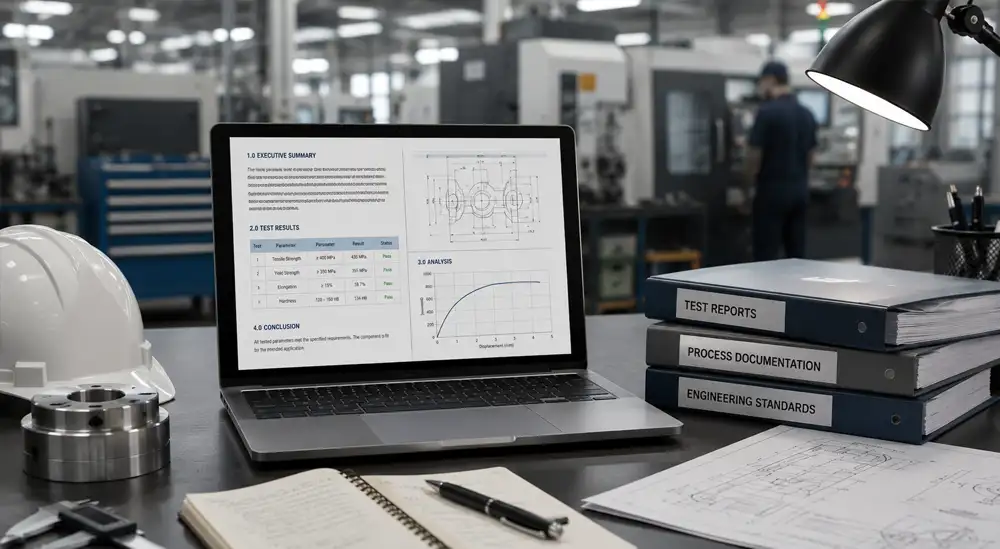
Most technical reports follow the same basic skeleton. You can add or remove sections depending on length, but this order rarely changes:
- Title page: report title, author, date, and document number.
- Executive summary: the conclusion, in three to five sentences. Busy readers often stop here.
- Table of contents: required for anything over a few pages.
- Introduction: the problem, the purpose, and the scope.
- Methodology: how the work was done, so a reader can judge if it was done correctly.
- Findings or results: the data itself, usually with charts or tables.
- Conclusions and recommendations: what the findings mean, and what to do next.
- Appendices: raw data, calculations, or supporting documents.
Skip a section only if it truly doesn’t apply. Readers expect this order. Breaking it slows them down.
Write the Executive Summary Last
Write the executive summary after you finish the report, not before. You can’t summarize findings you haven’t written yet.
Keep it short. Three to five sentences is enough. State the main finding first. State the recommendation second. Save the details for the body of the report.
Keep Sentences Short
Long sentences hide the point. Short sentences make it obvious.
Aim for sentences under 20 words. If a sentence runs longer, look for a place to split it into two. This one habit improves technical writing more than almost any other change.
Use the Active Voice
Passive voice hides who did what. “The test was conducted” doesn’t say who conducted it. “We ran the test” does.
Active voice is shorter, clearer, and easier to audit later. Use it by default. Save passive voice for the rare case where the actor truly doesn’t matter.
Separate Facts From Interpretation
A good technical report keeps two things apart: what happened, and what it means.
Put raw findings in the results section. Put your interpretation in the conclusions section. Mixing the two makes a report harder to trust, because the reader can’t tell which sentences are data and which are opinion.
Common Mistakes That Slow Readers Down
Some mistakes show up in almost every first draft we review:
- Burying the conclusion at the end, forcing readers to dig for it.
- Writing long, stacked sentences that pack three ideas into one.
- Overusing passive voice, which hides responsibility and adds words.
- Skipping the executive summary, so every reader has to read the whole report to find the point.
- Inconsistent terminology, using three different names for the same part or process.
We cover more of these in our full breakdown of common technical writing mistakes.
Formatting That Actually Helps Readers
Formatting isn’t decoration. It’s a map. Good formatting includes:
- Numbered headings that match the table of contents.
- Short paragraphs: three to five sentences at most.
- Bullet points for lists of three or more items.
- Consistent labels for every figure and table.
- Page numbers and a document version number on every page.
When to Bring in a Professional Writer
Some reports are simple enough to write in-house. Others carry more weight: regulatory submissions, safety investigations, or reports that go to a customer or auditor. In those cases, a professional technical writer catches ambiguity and inconsistency before it becomes a liability, not after.
The Bottom Line
Technical report writing is a skill, not a talent. Follow a consistent structure. Write short sentences. Use the active voice. State your conclusion early, and support it with clean, well-organized evidence. Do that, and most reports write themselves.
Related Resources
- How to Write a Table of Contents
- Common Mistakes in Technical Writing (and How to Avoid Them)
- Technical Writing Services
- Document Production Services
Frequently Asked Questions
What is the correct format for a technical report?
Most technical reports follow this order: title page, executive summary, table of contents, introduction, methodology, findings, conclusions and recommendations, and appendices. Skip sections only if they truly don’t apply.
How long should a technical report be?
Length depends on the subject, not a fixed rule. The executive summary should stay under five sentences regardless of the report’s total length, since it exists to save busy readers time.
What’s the difference between a technical report and a technical manual?
A technical report documents a finding, test, or investigation, usually for a specific decision. A technical manual explains how to operate, install, or maintain a product on an ongoing basis. Reports are typically one-time documents; manuals are living documents that get updated.
Should a technical report use passive or active voice?
Active voice, in most cases. Active voice states clearly who did what, which makes a report easier to read and easier to audit later. Passive voice is appropriate only when the actor genuinely doesn’t matter to the point being made.
Why does the executive summary come first if it’s written last?
Readers see it first because busy readers often only read the summary. It’s written last because you can’t accurately summarize findings and conclusions you haven’t finished writing yet.