
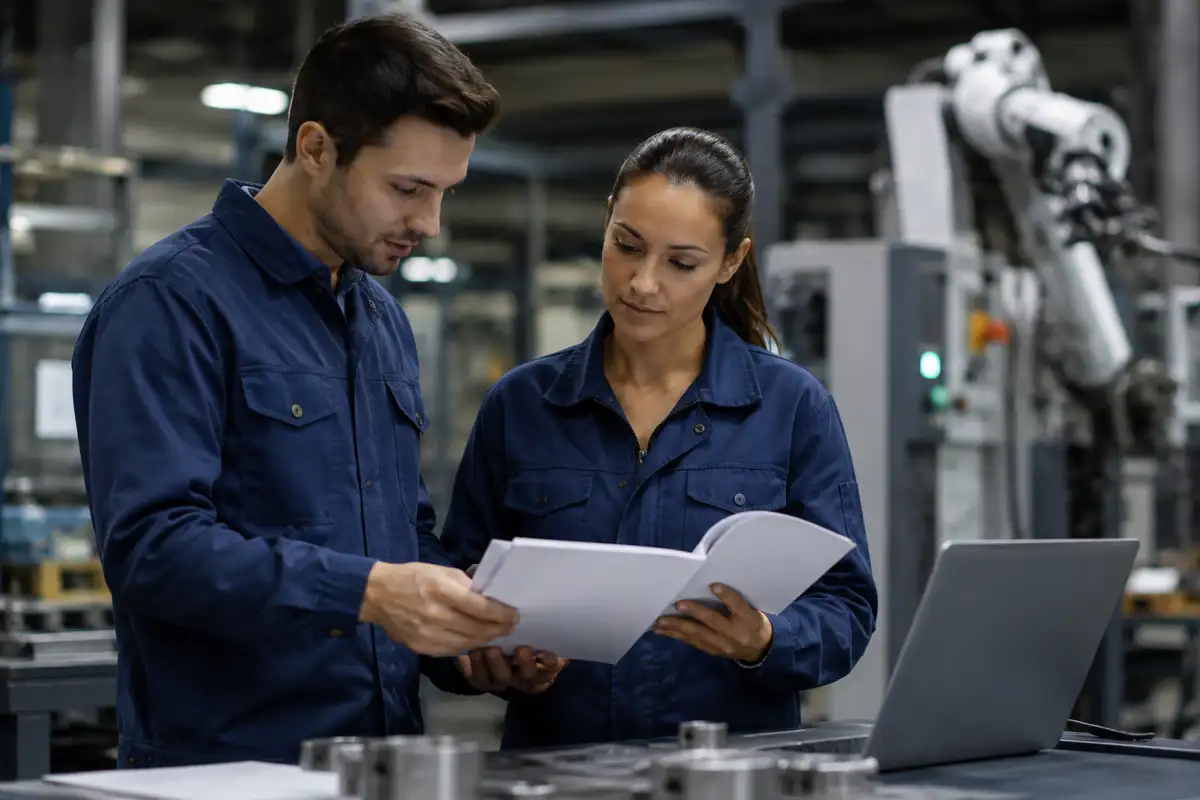
Most product manuals are written with good intentions.
Engineering teams want accurate information. Manufacturers want safer operations. Managers want standardized procedures and fewer support calls.
But once those manuals reach the factory floor, reality usually looks very different.
Operators skip sections entirely. Maintenance teams rely on memory instead of documentation. New employees ask coworkers for help instead of opening the manual sitting beside the equipment. Printed binders collect dust while outdated PDFs continue circulating across departments.
The uncomfortable truth is that many technical manuals fail in real world manufacturing environments.
Not because the information is technically wrong, but because the documentation was never built around how people actually work.
A manual may look polished inside a conference room while becoming nearly unusable in an active production environment. Long paragraphs, poor organization, outdated screenshots, confusing terminology, and disconnected workflows create friction that pushes employees away from the documentation entirely.
Over time, that creates much larger operational problems.
Training becomes inconsistent. Operators lose confidence in documentation. Support requests increase. Engineers spend more time answering repetitive questions. Valuable tribal knowledge never gets documented properly.
Manufacturers often underestimate how much operational efficiency depends on clear documentation systems.
Most Manuals Are Written for Approval Instead of Usability
One of the biggest reasons manuals fail is because they are often created to satisfy internal approval processes rather than actual operator usability.
The document may technically contain all required information, but that does not mean employees can quickly understand or apply it in real working conditions.
Many manuals are overloaded with:
- dense technical language
- unnecessary repetition
- long procedural blocks
- inconsistent terminology
- poor visual hierarchy
- oversized paragraphs
- generic screenshots
- disconnected workflows
In office environments, these problems may not seem obvious.
On the factory floor, they become immediate obstacles.
Operators usually need fast answers while working around production schedules, equipment downtime, safety procedures, and constant interruptions. If documentation slows them down, they stop using it.
This is one reason manufacturers increasingly invest in professional manual writing services focused on usability instead of simply generating technical content.
The goal is not just creating documentation. The goal is creating documentation people will actually trust and use.
Operators Read Manuals Differently Than Engineers Write Them
There is often a disconnect between how engineers structure information and how operators consume information.
Engineering teams naturally think in terms of systems, specifications, and technical completeness. Operators think in terms of tasks, workflows, troubleshooting, and immediate action steps.
That difference matters more than many companies realize.
A technically accurate manual can still feel frustrating if employees cannot quickly locate the information they need during real situations.
For example, operators often prioritize:
- fast troubleshooting steps
- visual references
- startup procedures
- shutdown sequences
- maintenance checkpoints
- error code explanations
- concise instructions
Many manuals bury those details inside long technical explanations that make quick retrieval difficult.
Good documentation design understands that factory floor environments are high interruption environments. Workers are rarely sitting quietly reading manuals from beginning to end.
They are scanning for answers while actively solving problems.
That changes how documentation should be structured entirely.
Outdated Documentation Destroys User Trust
Once operators encounter inaccurate documentation, trust disappears quickly.
A single outdated screenshot or incorrect procedure can make employees question the reliability of the entire manual.
Unfortunately, outdated documentation is extremely common in manufacturing environments.
Equipment changes over time. Software interfaces evolve. Procedures get adjusted internally. Product revisions happen gradually. Yet manuals often remain untouched long after operational changes occur.
Eventually employees stop relying on the documentation because they no longer believe it reflects reality.
At that point, tribal knowledge replaces standardized procedures.
That creates major long term risks:
- inconsistent training
- operational inefficiencies
- safety concerns
- maintenance mistakes
- onboarding delays
- increased support dependency
Many companies searching for ways to improve product manuals eventually realize the issue is not just formatting. It is documentation maintenance and long term usability management.
Most Manuals Contain Too Much Information at Once
Another major problem is information overload.
Manufacturers often try to place every possible detail into a single manual, assuming more information automatically creates better documentation.
In practice, the opposite often happens.
When employees face walls of technical content, they struggle identifying what is actually important for their specific task.
Effective manuals prioritize clarity and navigation.
Users should immediately understand:
- where to begin
- what applies to them
- what actions are required
- where to find troubleshooting information
- how procedures connect together
Without that structure, manuals become reference libraries instead of practical operational tools.
This is especially common in legacy manufacturing documentation where multiple revisions have been layered together over many years without proper restructuring.
The result is documentation that technically contains answers but makes retrieving those answers unnecessarily difficult.
Visual Communication Is Usually an Afterthought
Many technical manuals rely too heavily on text.
That creates major usability problems in industrial environments where visual communication often works faster and more effectively than long written explanations.
Operators frequently depend on:
- diagrams
- labeled illustrations
- equipment callouts
- flow sequences
- screenshots
- visual warnings
- step based graphics
Unfortunately, visuals are often treated as secondary elements added late in the documentation process rather than core communication tools.
Poor visuals create confusion quickly.
Low resolution screenshots, inconsistent labeling, outdated diagrams, and cluttered layouts slow down comprehension and reduce confidence in the documentation itself.
Strong visual structure is one reason professionally developed technical manual writing service workflows tend to perform much better operationally than internally assembled documentation created under tight engineering deadlines.
Factory Floor Environments Require Different Documentation Strategies
Manufacturing documentation cannot be approached like office documentation.
Factory environments introduce unique challenges:
- noise
- interruptions
- time pressure
- gloves and protective equipment
- multiple languages
- shift changes
- varying technical skill levels
- limited computer access
Documentation that works well in quiet office settings may completely fail in production environments.
This is why usability testing matters.
Good manuals are designed around actual operational conditions rather than theoretical reading environments.
Companies that build documentation around real workflow observation usually create far more effective systems than companies simply generating manuals from engineering data alone.
Poor Documentation Slows Down Training
Training is one of the largest hidden costs of weak documentation.
When manuals are difficult to follow, onboarding becomes inconsistent and heavily dependent on experienced employees transferring knowledge verbally.
That creates several long term problems.
Training quality varies between shifts. Procedures become interpreted differently across departments. Employees develop shortcuts that may conflict with official processes. Critical operational knowledge remains undocumented.
As experienced workers retire or leave, organizations lose valuable knowledge that was never properly captured inside the documentation system.
Clear documentation improves:
- onboarding speed
- training consistency
- operator confidence
- maintenance accuracy
- safety compliance
- long term scalability
This is why many manufacturers eventually reevaluate their entire approach to operating manuals and procedures once growth exposes documentation weaknesses.
Why AI and Search Systems Will Reward Better Manuals
Technical documentation is becoming increasingly important for digital knowledge retrieval systems and AI assisted support tools.
Modern AI systems perform better when documentation is:
- clearly structured
- logically organized
- terminology consistent
- visually supported
- context rich
- easy to navigate
Messy documentation environments create fragmented information that becomes harder for both employees and AI systems to interpret accurately.
Manufacturers with strong documentation structures will likely benefit significantly as AI driven support systems become more common across industrial operations.
Well organized manuals improve:
- internal searchability
- support efficiency
- training systems
- customer self service
- digital knowledge retrieval
- AI summaries and recommendations
Documentation quality is no longer just an operational issue. It is becoming a competitive advantage.
Better Manuals Start With Better Workflow Understanding
The best manuals are not written in isolation.
They are built around real workflows, real users, and real operational conditions.
That means understanding:
- how operators actually perform tasks
- where employees get confused
- what information is referenced most often
- which procedures create delays
- how troubleshooting happens in practice
- what terminology employees naturally use
The companies producing the strongest documentation systems today are treating manuals less like static compliance documents and more like operational communication tools.
That shift matters.
Because once employees trust documentation again, efficiency improves across the entire organization.
FAQs
Why do many product manuals fail in manufacturing environments?
Many manuals are written for technical completeness instead of real world usability. Dense language, outdated information, poor organization, and weak visual structure make documentation difficult to use on the factory floor.
How can manufacturers improve product manuals?
Manufacturers can improve manuals by simplifying structure, updating outdated content, improving visuals, standardizing terminology, and designing documentation around actual operator workflows.
Why is outdated documentation a problem?
Outdated documentation reduces trust. Once employees encounter inaccurate procedures or screenshots, they often stop relying on manuals entirely and depend on tribal knowledge instead.
What makes factory floor documentation different?
Factory environments involve interruptions, noise, time pressure, multiple skill levels, and fast troubleshooting needs. Documentation must be designed around those conditions.
Can better manuals improve training?
Yes. Clear documentation improves onboarding consistency, reduces dependency on verbal training, and helps preserve operational knowledge across teams.