
Article Summary
Right-to-repair laws are spreading across the U.S. and Europe. They push manufacturers to share parts, tools, and repair information. This guide explains what those laws generally ask for. It then lists the documents a repair-ready package should include and shows how to build it without starting over.
What Right to Repair Means
Right to repair means owners can fix their own products. They can also hire an independent shop. To do that, they need access to the right information and parts.
Most laws ask manufacturers to make four things available:
- Replacement parts
- Repair tools
- Diagnostic software
- Repair documentation
This article focuses on the last item. Documentation is the piece your writers, illustrators, and translators control.
What Is Happening Now
The movement is growing fast. Here is a quick snapshot.
- Six state laws took effect at the start of 2026. About one in four Americans then lived in a state with right-to-repair protection.
- Connecticut and Texas rules were scheduled to start in July and September 2026. Coverage was expected to pass one in three Americans.
- Right-to-repair bills have been introduced in every state. Federal bills for electronics and vehicles were also moving through Congress in 2026.
- Colorado passed the first farm equipment law in 2023.
- Wisconsin lawmakers introduced a farm equipment bill in the 2025-26 session (Assembly Bill 147 and Senate Bill 148). It would require manufacturers to provide documentation, data, embedded software, firmware, parts, and tools on request, at fair terms.
- The EU set July 31, 2026 as a key date for its own repair rules.
Laws differ by state and by product. Read the law that applies to you.
Does This Apply to You?
Many current laws focus on consumer electronics, appliances, farm equipment, wheelchairs, and vehicles. Heavy industrial machinery is often outside them today. Scope can change, and it varies by state.
Check three things:
- Product type. Is your product named or described in the law?
- Who buys it. Some laws cover consumers. Others cover business buyers too.
- Price and age. Some laws set support periods by price. In California’s SB 244, for example, the period for certain products runs three years or seven years, depending on price.
Even if you are outside the law, the trend matters. Dealers, customers, and independent shops now expect clear repair information. Good repair documentation can also cut support calls.
What a Repair-Ready Documentation Package Includes
| Document | What it holds | CPG service |
|---|---|---|
| Service manual | Repair steps, diagnostics, specs, torque values, and tools | Technical Writing |
| Parts catalog | Exploded views, part names, and part numbers | Rendering and Database Publishing |
| Schematics | Wiring, hydraulic, and pneumatic diagrams | Rendering and Technical Illustration |
| Fault code and troubleshooting tables | Symptoms, causes, and fixes | Technical Writing |
| Software and firmware notes | Update steps and version history | Technical Writing |
| Tool and test equipment list | What a technician needs for each job | Technical Writing |
| Safety warnings and skill notes | Hazards, lockout steps, and who should do the work | Document Production |
| Revision history | What changed and when | Document Production |
Not sure how these differ? See manual types explained. For a deeper look at each type, read about owner’s, operator’s, parts, and service manuals.
Exploded Views and Parts Data Come First
Repair starts with the right part. A wrong part number wastes time and money. It can also create a safety risk.
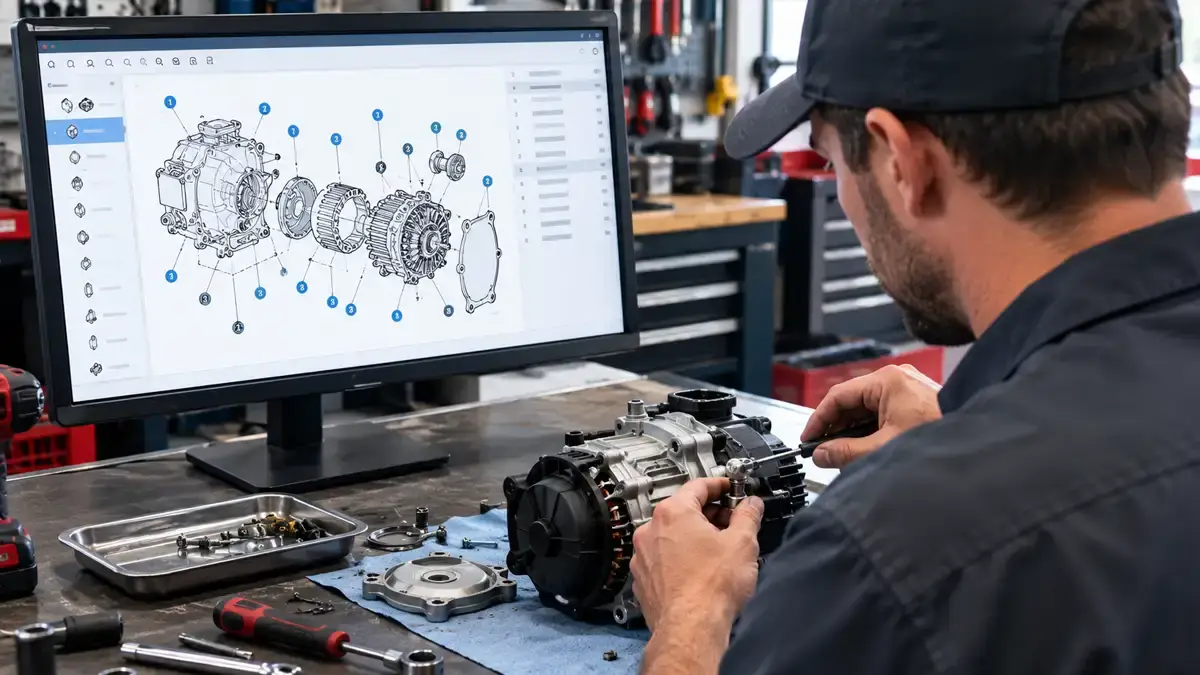
Exploded views show how parts fit together. Learn the basics in what are exploded views. Many teams build them from CAD data. Read how to create illustrations from 3D models.
Parts change often. So the catalog must change with them. Database publishing keeps part names, numbers, and pages tied to one source. When the data changes, the catalog updates with it.
Who Gets Access, and How
Laws often use words like “fair” and “reasonable.” Some allow fair pricing. Some protect trade secrets. The Wisconsin bill, for example, speaks to fair costs and trade secrets.
Plan your access model early:
- Public site: Open to anyone. Best for owner-level repairs.
- Dealer or partner portal: Gated for approved shops.
- On request: A clear form and a fast response.
Your legal team should set the rules. Your documentation team should make sure the content is ready for any option.
Translation for Field Technicians and Export Markets
Repair information must be understood to be useful. Many U.S. shops rely on Spanish-speaking technicians. Export markets have their own languages.
Keep part names and numbers identical in every language. Use approved terms. Avoid common slips, such as those in Spanish technical translation mistakes. Our translation team can help.
Safety and Liability
When more people repair your products, safety information matters more. Put warnings before the steps they protect. Say who should do the work. Include lockout steps and tool needs.
Some bills include liability protection for manufacturers when others do the repair. Details vary, so ask your legal counsel. For the documentation side, read documentation mistakes that lead to product liability lawsuits.
Keep It Current
Outdated repair information is worse than none. Set a simple update process. Tie it to engineering changes. Our advice on manual updates after product changes can help.
Clean, well-labeled documents also work better with chatbots and search tools. See why AI chatbots get your manuals wrong. If you sell in the EU, also read our EU Machinery Regulation manual checklist.
Eight Steps to Get Ready
- Check which laws apply. Review your products, states, and buyers.
- List your documents. Note what exists for each product.
- Find the gaps. Compare your list to the table above.
- Fix parts data first. Make sure names and numbers are correct.
- Update the illustrations. Add exploded views and schematics where they are missing.
- Decide on access. Choose public, gated, or on request.
- Translate what you need. Match your field and export markets.
- Set an update process. Tie it to product changes.
How CPG Documentation Can Help
CPG Documentation prepares the documents. We do not give legal advice. Your counsel decides what the law requires. We make the content clear, accurate, and ready to publish.
- Technical Writing: Service procedures, diagnostics, and troubleshooting tables.
- Rendering and Technical Illustration: Exploded views and schematics.
- Database Publishing: Parts catalogs built from one data source.
- Translation: Repair content in the languages your technicians use.
- Document Production: Consistent layouts, revision control, and print or digital files.
Want to see where your repair documents stand? Contact CPG Documentation to start the conversation.
Related Reading
- Every manufacturer needs an installation manual
- What documentation do I need to avoid product recalls?
- Technical illustrations from CAD files
- OSHA documentation requirements for equipment manuals
Frequently Asked Questions
What is right to repair?
Right to repair is the idea that owners and independent shops should be able to fix products. Laws usually require manufacturers to provide parts, tools, diagnostic software, and repair documentation on fair terms.
Which documents do right-to-repair laws usually cover?
Laws often mention repair manuals, schematics, parts information, and diagnostic information. The exact list depends on the law and the product. Read the law that applies to you.
Do right-to-repair laws apply to industrial machinery?
Many current laws focus on consumer electronics, appliances, farm equipment, wheelchairs, and vehicles. Industrial machinery is often outside them today. Scope varies by state and can change, so check your product and your markets.
What should a repair-ready documentation package include?
A repair-ready package usually includes a service manual, a parts catalog with exploded views, schematics, fault code tables, software notes, a tool list, safety warnings, and a revision history.
Do I have to share trade secrets under right-to-repair laws?
Some laws and bills include protection for trade secrets. Details differ by jurisdiction. Ask your legal counsel what applies to your products.
Is there a federal right-to-repair law?
Federal right-to-repair bills for electronics and vehicles were pending in 2026. Check current status, because bills can move quickly.